 EN
EN  FR
FR  FR
FR 


Sports glasses is a category of sunglasses, but they are not the same depending on the type of sport you want to practice. Between winter and summer sports, it's not always easy to find the right pair of sports glasses. Today, Mymonture gives you all the advice you need to find the right pair of sports glasses.
The different lens classes
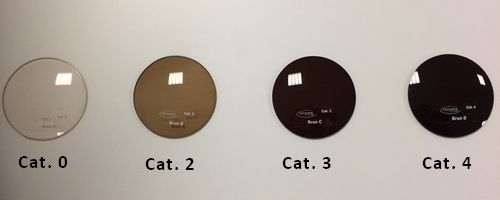
First of all, let's take a look at the different tints of sunglasses. There are 5 different tints, which influence the luminosity transmitted through the lenses.
Class 0: This is the weakest protection class, blocking between 0 and 20% of light rays, and is mainly used for aesthetic purposes. This category of lenses does not provide effective protection against ultraviolet radiation.
Class 1: Protection class 1 blocks between 20% and 57% of light rays. It's ideal for low-sunlight situations.
Class 2: Protection class 2 blocks between 57 and 82% of light intensity. This solar protection is effective for medium sunlight situations.
Class 3: Protection class 3 is the most widely used because it is the most versatile, blocking between 82 and 92% of light intensity.
Class 4: Class 4 blocks the most light rays (over 92%). It's ideal for water sports and various winter sports. However, this type of glass cannot be used for driving, as it is too opaque.
Glass and its qualities
When it comes to glass material, organic glass is best suited to sporting activities. They are also lighter and more impact-resistant than mineral lenses.
The lens can also be polarized to limit glare and offer optimum visual comfort. You can find out more in our article on polarized lenses.
Tinting not only has an aesthetic role to play, but also has a real impact on visual comfort, depending on your needs. For example, gray lenses are recommended if you want a faithful reproduction of colors.
Brown lenses improve contrast, making them popular with skiers and cyclists. Yellow lenses are more effective in low light conditions, especially for skiing.
Different frames for different activities
If you practice an endurance sport such as running or cycling, the ideal frame is high and wide. A lightweight model with thin temples is also preferable for cycling.
Our selection of frames for endurance sports.
When it comes to water sports, a hydrophobic coating is just what you need, so that water slides more naturally over the surface of the lenses. The frame should also be light and buoyant, so that it can be easily retrieved. As water reflects light, polarized or category 4 lenses are highly recommended.
Our selection of frames for water sports.
For high-altitude activities such as hiking or any type of winter sport, category 4 lenses are strongly recommended, as well as a frame with high coverage to protect the eye from UV rays. Brown lenses are also recommended, as they help to better perceive contrasts.
Our selection of frames for high-altitude activities.







 Loading...