

We talked about this at length in our article on children's visionand in our article on low visionbut what does visual acuity actually mean? Mymonture explains how it quantifies the quality of an individual's vision.
First, we'll look at what visual acuity is and how it's defined, then at the methods used to assess it, and finally, is it possible to have visual acuity of over 10/10?
What is visual acuity?
Visual acuity is a measure of an eye's ability to discern objects, or parts of objects, and to distinguish details. The more the eye is able to distinguish small details close together, the higher the acuity of the eye is considered to be. This is called the separating power of the eye, i.e. the minimum angle that enables the eye to separate two points.
How is acuity assessed?
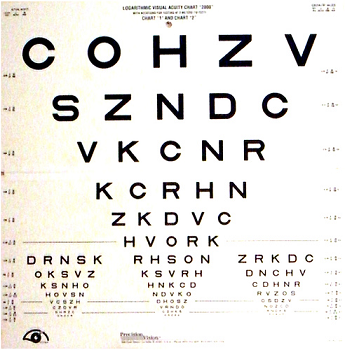
When you go to the ophthalmologist, he or she will probably have made you read lines of letters or numbers until reading becomes impossible. The aim of this assessment is to determine the limit of your separating power, and thus your acuity.
How to explain this? Let's take the letter "E" as an example. If you have normal vision, it will appear legible when you see it large. However, the more the letter shrinks, the closer the elements of the letter get to each other, making them harder for your eyes to distinguish, as they are harder for your brain to analyze.
The scale generally used by ophthalmologists ranges from 1/10 to 10/10, this acuity being the minimum required for comfortable vision in everyday life.
What causes acuity to drop?
Acuity declines as a result of various eye disorders.
Myopia, hyperopia or astigmatism combined with the first two modify the zone of convergence in our eye, distorting and "blurring" our vision. The ophthalmologist, thanks to his various tests, can find the correction the patient needs to achieve maximum acuity.
There are also other disorders, such as amblyopia, which prevents the eye from achieving adequate acuity (even with optimal correction) and results in low vision.
Is it possible to achieve visual acuity of over 10/10?
Of course, 10/10 is the minimum acuity required for comfortable everyday vision. But acuity is often higher than 10/10 if the individual is perfectly well corrected. Acuity once corrected (or if no correction is required) depends on physiological factors in the retina.
As we saw in the article on color blindnessthe retina is lined with cells (cones and rods), so each individual's maximum visual acuity will depend on the arrangement of these different cells. The smaller the distance between each cell, and therefore by extension the greater the number of cells on the retina, the greater the visual acuity.
Today, it is estimated that some people have visual acuity of the order of 20/10.







 Loading...