 EN
EN  FR
FR  FR
FR 
Myopia, hyperopia and astigmatism are terms often used by health professionals, but which can sometimes seem unclear to the general public. Mymonture explains what's behind these words.
First of all, don't worry: having a vision problem is in no way a disease or pathology. Today, over 25 million people in France have vision problems. Let's take a closer look at each of these disorders, and find out how to diagnose and treat them.
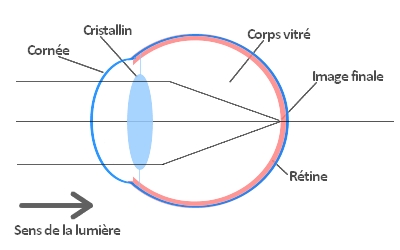
Before reviewing the various disorders, let's take a closer look at the diagram of a normal eye. Light entering the eye is refracted and converges on a point. In this case, the point is coincident with the retina, resulting in a sharp image.
Myopia
Myopia is the most common eye disorder, and very easy to diagnose. Usually appearing during childhood, the affected person will have difficulty seeing at a distance, and will squint to try and improve their vision. Myopia may also trigger headaches, but this is less common.
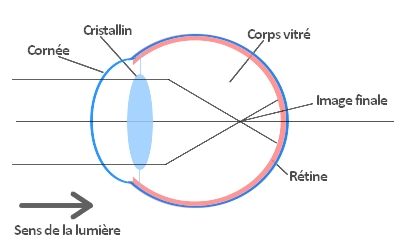
How does it happen? A myopic eye is generally one that is longer than average, which also causes the cornea to bulge. As shown in the diagram, a myopic eye will not have a final image formed on the retina but in front of it, resulting in the creation of a diffusion spot and blurred vision.
The myopic eye may also be too powerful, causing light rays entering the eye to converge excessively, with the same consequence.
However, because the myopic eye is more powerful, it requires less effort to see up close.
To correct myopia, lenses with negative powers are prescribed, to bring the final image forward on the retina.
Hyperopia
Hyperopia is more rare, and is in some ways the opposite of myopia. The eye is not powerful enough and/or too short, and light rays converge behind the retina.
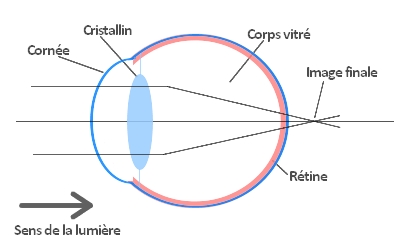
A hyperopic person must therefore make an effort to see at a distance, and an even greater effort to see up close.
Unlike myopia, this disorder is not easily detected, and someone with mild hyperopia may be unaware of it for a long time before discovering it.
Warning signs include headaches, stinging or shooting pains in the eyes, and difficulty in reading for long periods.
Unlike myopia, hyperopia is treated with positive-power lenses to make the image recede on the retina.
Astigmatism
Astigmatism is caused by a deformation of the cornea, which is no longer completely spherical. This anomaly results in a difference in power between the different axes of vision, which can lead to slightly distorted vision.
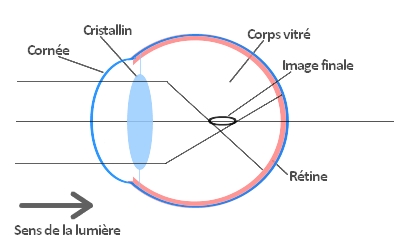
Astigmatism is often coupled with myopia or hyperopia, and can lead to blurred vision both near and far.
It can also lead to headaches and visual fatigue.
To correct astigmatism, we use spherocylindrical lenses, which do not have the same power along the axis, thus making up for the difference caused by astigmatism.
Presbyopia
Presbyopia is not one of the aforementioned disorders. Presbyopia is an inescapable condition in which the crystalline lens, used to accommodate near vision, loses its flexibility. As a result, near vision becomes more difficult around the age of 45.
To correct presbyopia, the best solution is to wear progressive lenses. These are custom-made for each wearer, and provide clear vision at all distances.
To correct your eyes in all circumstances, it's important to have top-quality lenses. Mymonture can help you choose the lenses that best suit your needs from a vast selection of guaranteed French origin products.






 Loading...