 EN
EN  FR
FR  FR
FR 

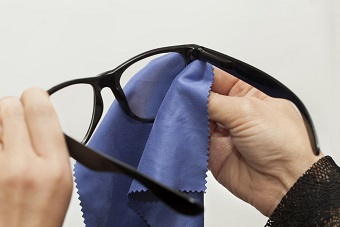
Initially, there were two possibilities in terms of lens materials: mineral (glass material) and organic (plastic material). Today, however, mineral materials are rarely used, except in exceptional cases.
Once a lens has been chosen, certain treatments can be applied, such as hardening, anti-reflective coating, etc. But what is the real purpose of all these treatments? What are they used for and how are they applied? Mymonture reveals all the secrets!
Hardened coatings
Hardened coatings are applied to organic (i.e. plastic) lenses to limit scratches and make them stronger for everyday wear. It's a treatment that's often applied and also recommended to protect your lenses from scratches.
But how do we apply this hardened coating to our organic glass? We use the " dip coating " method, in whichthe glass is immersed in a varnish bath. As it hardens, the varnish becomes harder than the glass, protecting it from external aggression.
In short, organic glass has many advantages: it's impact-resistant, lightweight... But its greatest weakness is that it scratches easily, which is why at Mymonture, all our lenses are automatically treated with the hardened coating.
Anti-reflective coating

Without anti-reflective coating With anti-reflective coating
Anti-reflective coating is probably one of the most talked-about coatings, of which there are many, including anti-reflective coating against blue light, to which we'll return later.
The surface of each lens undergoes a reflection phenomenon, which creates residual reflections that can be annoying for the wearer. By applying an anti-reflective coating, we create an interference that cancels out the reflections, therebyincreasing light transmission. The benefits of this type of treatment are therefore :
-lenses that appear more transparent, for a more aesthetic result.
- improved visual comfort, especially when driving at night.
But how is the coating applied? The lenses are vacuum-coated to increase the effectiveness of the treatment, and then several layers are applied to both sides of the lens.
As with the hardened coating, the glass is thoroughly cleaned before treatment to remove any particles that may be present.
Anti-blue-light treatment

The "anti blue light" treatment we've been talking so much about for the past two years is actually an anti-reflective treatment, but somewhat improved, and it's interesting to see what it can do for the user.
Our starting point is an observation: blue light has an impact on our vision and, more generally, on our daily lives. Indeed, the vast majority of our daily blue light comes from our screens. So what's happening now? We're spending more and more time behind our computers, tablets and smartphones, and our eyes aren't made for it.
What does this mean? There are two main consequences:
- Damage to the retina, which lines the back of our eyes, and can lead to macular degeneration.
- Dysfunction of the internal clock. Our bodies need a certain amount of blue light to function properly. However, if it receives too much, our internal clock can go haywire. In concrete terms, our brains become confused about the time of day, which can lead to mood and sleep disorders if we spend all day in front of a screen.
However, these lenses do not block all blue light (which is nonetheless essential for our bodies to function properly), but only the harmful ultraviolet part. You can find our blue light protection under the name "Blue Clear" when you place your next order
Photochromic lenses (Transition)
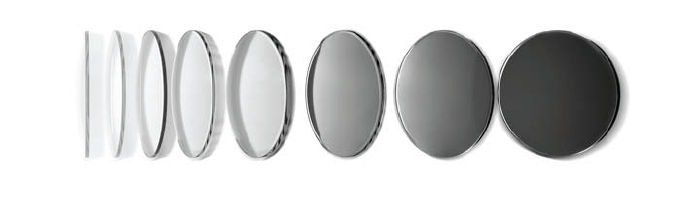
Evolution of tint with brightness
Behind this complicated name lies a lens that "tints in the sun", but how does it work?
Under the influence of UV light, chromophore molecules reversibly change shape, which means that the lens can become more or less tinted depending on the brightness of the sun.
So, when you wear photochromic glasses, your lenses are perfectly transparent when you're indoors, protected from UV rays, and tinted when you go outdoors, to protect your eyes from UV rays. Conversely, when you return indoors, the lenses gradually revert to white.
How is the coating applied? On organic lenses, photochromic molecules are uniformly introduced on the surface over a thickness of around 0.15 mm. In the case of mineral lenses, the molecules are integrated into the mass.
Sun lenses
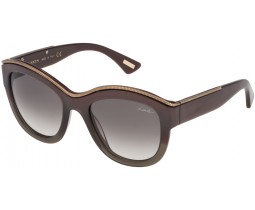
Lanvin gradient frame
Sun lenses are very common and are used to protect against glare and UV rays. They can be tinted uniformly or in a gradient.
How are sunglasses made?
Organic lenses are tinted by soaking in baths of the desired color. The darker the lens, the longer it is soaked in the bath.
Mineral glass, on the other hand, is tinted in the mass.
NB: Please note that just because your lenses are tinted doesn't mean they actively protect you from UV rays. Mymonture recommends that you always make sure that the sunglasses you buy fully protect you against all UV rays, in accordance with CE standards.
Polarized lenses

Classic sunglasses Polarized lenses
Before talking about polarized lenses, let's take a closer look at light rays. Light waves vibrate in all directions, which means that when it's sunny, even with classic sunglasses, you can be bothered by reflections caused by light waves reflecting in all directions.
How do polarized lenses counteract this phenomenon? By blocking horizontal rays and allowing only the vertical component of light to pass through, thus reducing glare.
Polarized glass is improved solar glass. How does it work? A polarizing film is integrated into the glass during manufacture. This polarizing film filters out 100% of UV rays and cuts all horizontal light rays.
What are the practical effects of polarizing glass in everyday life? As mentioned above, polarizing glass reduces glare, thanks to its ability to separate "useful" light from reflected light. The difference will be noticeable, for example, when driving orplaying sports. In addition, polarized lenses enhance the sharpness of colors and contrasts, and improve the perception of relief and distance. Click here to see our selection of polarized lenses
The various lenses and coatings now hold no secrets for you. In addition to providing you with guaranteed French-origin lenses, Mymonture offers you equally high-quality coatings that will satisfy you at every opportunity.







 Loading...