 EN
EN  FR
FR  FR
FR 


The warm weather has been with us for some time now, allowing us to spend more and more time outside in the sun. However, we mustn't forget that the sun sends out light waves called UV rays, which can be harmful to our retina. Today, Mymonture explains how to make sure you're properly protected against the sun.
Before getting to the heart of the matter, it's important not to confuse glare with UV. Just because a pair of sunglasses won't dazzle you doesn't mean they'll protect you adequately from harmful rays. It's always a good idea to check that the lenses you've bought are CE marked, which means they're of good quality and guarantee UV protection.
White lenses
Contrary to popular belief, white lenses protect against harmful UV rays, sometimes even 100% if they are fitted with a specific anti-reflective coating (in this case, the High Definition coating in our range, which guarantees 100% UV protection).
Photochromic coating is the treatment that tints white lenses in the presence of UV light. So, with photochromic lenses, your optical equipment will tint in the presence of UV and therefore sunlight, allowing you to have an indoor pair and an outdoor pair on the same equipment.
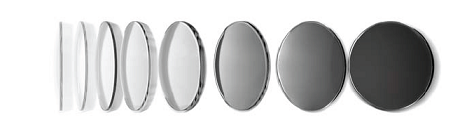
Progressive tinting of photochromic lenses
How does it work? Quite simply, a specific oxazine-based treatment is deposited on the lens surface. When this treatment is exposed to UV light, the bonds between the molecules break, causing the glass to tint. When the glass is returned to normal condition, the bonds are reconstituted, restoring its clarity.
For more information on photochromic lenses, please read our article on the different coatings.
Sun lenses
Sunlenses come in a range of protective categories, and can be used in a variety of situations.
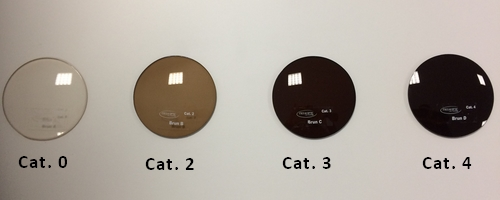
The different lens tints
- Categories 0 and 1 are more of an aesthetic nature, and do not really provide protection against glare. Category 1 lenses filter out up to 57% of the sun's rays, and can therefore be used in reduced sunlight conditions, such as in winter or on grey days.
- Category 2 lenses filter out between 58% and 82% of the sun's rays, making them ideal for moderate sunlight.
- Category 3 lenses are the most widely used because of their versatility. Effective in most sunlight situations, they filter out between 83 and 92% of the sun's luminous intensity. They are therefore highly recommended for summer use, such as on seaside vacations.
- Category 4 lenses offer the best protection against glare, filtering out up to 97% of light intensity. They are also often coupled with a mirror coating that increases light reflection. This type of lens is ideal for use in the mountains in winter, as it provides perfect protection from reflected snow rays, which can be particularly harmful to the retina. Be careful, however, as this type of lens cannot be used for driving, as it impairs vision and color perception.
If you're into mountaineering or any other mountain activity, I invite you to take a look at our selection of frames fitted with category 4 protective lenses.
There's another type of sunglass lens: polarized lenses. Some eyewear brands, such as Polaroid and Invu, have made polarized lenses their specialty, but what exactly are they?
Polarized lenses are sunglasses (mainly category 3) with a polarizing filter interposed in the center of each lens. The purpose of polarized lenses is to limit the various types of glare that can occur in bright sunlight, such as the reflection of light on water in summer.

The influence of polarized glass
In any case, all the sunglasses we offer at mymonture guarantee optimum protection against harmful UV rays. In terms of lens categories, we work mainly with category 3 lenses for everyday use, and we also offer a range of category 4 lenses for mountain protection.







 Loading...