 EN
EN  FR
FR  FR
FR 


Progressive lenses are a much-talked-about piece of equipment, used by a multitude of people, but not necessarily easy to understand. How do they work? This week, Mymonture takes a look at the specifics of this lens and tells you everything you need to know about progressive lenses and near vision.
First of all, let's ask ourselves the question: why do we need to wear progressive lenses? In fact, it's the question that everyone has the right to ask: why does our ophthalmologist suddenly prescribe this type of lens?
The answer is physiological and quite simple: presbyopia. Presbyopia is a normal phenomenon that affects everyone without exception, on average from the age of 45. What exactly happens? The crystalline lens, our eye's inner accommodating element, hardens with age, making it naturally more difficult to contract for close-up vision. For more information, please consult our article on eye disorders.
As the crystalline lens no longer performs its function correctly, the person affected is unable to "focus" up close, resulting in blurred vision from 40-50 cm away.
How can this presbyopia-induced effect be countered?

When a person becomes presbyopic, it becomes difficult to see close-up, so a near vision correction is used to replace accommodative power, helping the person to focus close-up and see clearly.
Near vision correction can be applied in a variety of ways, with different types of lenses being used to varying degrees of effect, depending on how you use them.
The different types of lenses
First of all, single vision lenses with positive power. The positive power provided by the lens will enable you to see well at close range (provided the power is appropriate and the lenses are correctly centered), but when wearing such lenses you will see blurred images at a distance, as you will not be able to focus at a distance. Single vision near lenses can be useful for people with no basic correction, and who don't spend much time in near vision. As these are so-called classic lenses, their cost is lower than that of progressive lenses.
Then there's a second category: degressive lenses, also known as mid-distance lenses. The technology of this type of lens is similar to that of progressive lenses. In fact, a degressive lens provides clear near and intermediate vision, ideal for computer work with a wide field of vision. However, unlike progressive lenses, this type of lens does not correct for distance.
We'll now take a look at progressive lenses in general. These lenses provide clear vision at all distances, i.e. distance, intermediate and near. But how do you get a single-surface lens that can offer different correction powers?
The manufacture of progressive lenses
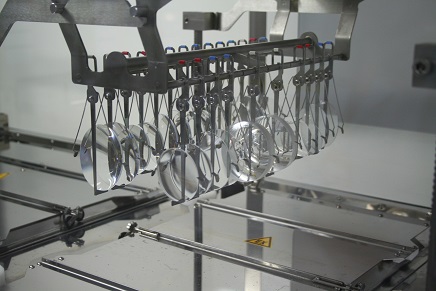
The manufacture of progressive lenses
What makes progressive lenses so complex is their so-called " free-form " or point-by-point manufacture (and this also explains their higher selling price compared to single-vision lenses).
The starting point is a semi-finished lens, the front of which is spherical and has a single power. A machine then works point by point on the back surface to give each part of the lens a specific power.
A progressive lens is therefore by definition a lens with an infinite number of powers, capable of correcting from distance to near vision with the smoothest possible transition.
As you can see, the various measurements required to fit progressive lenses are invaluable, and that's why at mymonture we make a point of letting you try on your frame before the final fitting, to make sure it suits your face shape and also to take the necessary measurements such as half pupillary distance and height.
The different progressive lens ranges
Now that we've taken a general look at the manufacture and principle of this type of lens, how do we explain the fact that there are several different ranges of progressive lenses? Why is there a price difference between traditional progressive lenses and high-performance progressive lenses?
Comfort and the width of the field of vision play a major role in the price difference. Another important parameter is peripheral aberration. Peripheral aberration is a phenomenon that is now inevitable with this type of lens: the left and right peripheral parts of the lens at close range will not be clear to the wearer. However, the higher the performance of the lens chosen, the more aberrations can be reduced, providing the wearer with additional comfort.

Aberrations on traditional progressive lenses

Aberrations on high-performance progressive lenses
The two diagrams above show a traditional progressive lens and a high-performance progressive lens respectively. The blue zones correspond to the available vision zones and the orange zones to the peripheral aberration zones.
Getting used to progressive lenses

Adapting to progressive lenses for the first time can be a complex process, but don't worry: there's an adjustment time for everyone when it comes to wearing progressive lenses for the first time, and you'll need to get used to them gradually before you're totally accustomed to them.
We also recommend not wearing them all day long at the start of adaptation, but rather for a few hours each day. And don't forget that the earlier you adapt to progressive lenses, the easier it will be.
The good news is that once your brain has got used to progressive lenses, and memorized the gaze zones, your eyes will look directly into the right zone without you even having to think about it.
Summary of close-up lenses

Have you recently been experiencing difficulties with close-up vision and don't know which lens solution to choose? No need to panic:
You occasionally use near vision (no more than an hour a day), you often perform tasks requiring precision at close range, you often read, and you have no correction for distance vision: prefer single vision lenses for near vision, they will give you a wide field of vision and will be sufficient for your near vision tasks.
If you work on a computer at medium distance, and often go back and forth between close-up vision and your screen, the best choice is a tapered lens, which will give you comfortable vision and a wide field of vision in both close-up and intermediate vision.
Do you already have distance vision correction (myopia, hyperopia or astigmatism) and are you looking for a solution to see clearly at any distance at any time of day? Progressive lenses are undoubtedly the best solution.
At mymonture, we've chosen to work exclusively with Mega Optic, a subsidiary of lens manufacturer Essilor, renowned for its top-quality lenses. Our Mega Optic lenses also benefit from the guaranteed French-origin label, enabling us to offer you lenses that perfectly meet your every need in terms of visual quality, while remaining reasonably priced.








 Loading...