 EN
EN  FR
FR  FR
FR 


How do I read a prescription? What do the numbers, signs and brackets mean? These are just some of the questions that arise when ordering products. Mymonture tells you everything you need to know to make sure you never make a mistake when ordering.
First of all, a quick reminder of how long prescriptions are valid. Prescriptions are valid for 5 years for those aged 16-42, 3 years for those over 42 and one year for those under 16. For contact lenses, the prescription is valid for one year for everyone, as this requires special monitoring by the ophthalmologist.
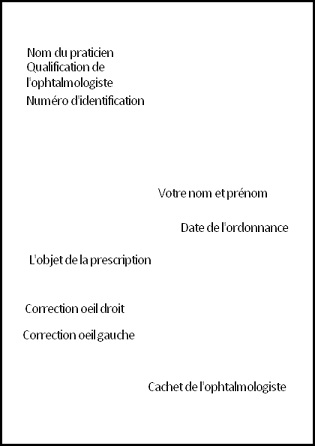
Here's a little diagram explaining each part of the prescription:
Let's start with the ophthalmologist
Firstly, we have his or her name, qualifications (title, place of practice, address, etc.) and a very important piece of information, his or her ADELI number, or identification number.
Starting with the number of the department in which the practice is located, it consists of 9 digits. The ophthalmologist's stamp and/or signature must also appear if the prescription is to be valid.
Another important piece of information is the prescription date, which makes it possible to date the prescription and thus determine whether or not it is valid.
The purpose of the prescription corresponds to what the patient needs, which may be progressive equipment, distance vision equipment, near vision equipment or contact lenses. This is essential information, as contact lenses cannot be dispensed with a prescription for frames + lenses, and vice versa.
Finally, let's look at the most important part of the prescription: the correction itself.
The sign
The sign in front of the first number tells us the nature of your visual problem. If it's a +, it means you're hypermetropic, and if it's a -, it means you're myopic.
The number
The number behind the sign corresponds to the intensity of your visual problem, and is known as the "sphere". The larger the sphere, the greater the correction you need.
What about brackets?
You may have numbers in brackets included in the correction. This means that you have an astigmatism, which corresponds to the "cylinder" (for more information on vision disorders, click here to read our article on the subject). The number in brackets corresponds to the power of your astigmatism, and the number expressed in degrees immediately after the brackets corresponds to the axis of your astigmatism.
Corrections for progressive lenses
If you wear progressive lenses, the word " add " will appear after the brackets. The figure is generally between 0.75 and 2.50, and corresponds to the addition you need to see clearly at close range without extra effort.
Let's take an example
Case 1
OD: +0.75 (-0.50) 150
OG: +1.25
In this case, the correction is intended for distance vision only, so single vision lenses will be used. In addition, the patient is hypermetropic in both eyes and astigmatic in the right eye. When ordering, the patient will be able to complete his characteristics in this way:

Let's take a second example
Case 2
OD: -2.75 add +1.50
OG: -2.00 add +1.50
We now have a correction requiring progressive lenses (due to the presence of an addition). We can also note that the patient is myopic because he has a negative sphere, andthere isno astigmatism.
When he places his order, he will be able to complete his characteristics as follows:

Pupillary distance
To ensure optimum fitting, mymonture also needs your pupillary distance. This is the distance between the center of your pupils and the middle of your nose. These should appear on your prescription, and you can ask your ophthalmologist for them if you don't have them.
And because mymonture likes a job well done, we'll send you the frame you've chosen to your home before fitting. You then send us a photograph of yourself wearing the frame, which enables us to offer you impeccable centering.







 Loading...