 EN
EN  FR
FR  FR
FR 


Choosing the right size of glasses isn't always easy: a frame that's too big can be uncomfortable because it's not stable, and one that's too small for your face can hurt your temples. Today, Mymonture gives you all the advice you need to choose the right frame size.
Choosing the right frame size isn't easy when you don't know what the different numbers on the frame mean. Let's take a look at these numbers to understand them better.
Lens width
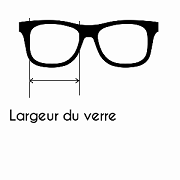
Lens width is a number generally between 40 and 60 mm, followed by a square on the temple. As shown in the diagram below, it corresponds to the width of the lens at both ends.
Nose width
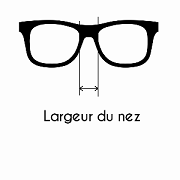
The width of the nose is a parameter that also appears on the frame temple, separated from the width of the lenses by a square, and corresponds to the distance separating the two lenses on the nasal side, as shown in the diagram below. This measurement is generally between 15 and 25 mm.
Temple length
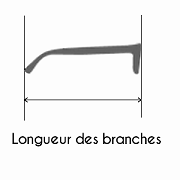
Temple length is the distance between the side of the frame, seen in profile, and the end of the sleeves, as shown below. This measurement is generally between 130 and 150 mm.
So, if you can't find the numbers corresponding to the different measurements of your frame, you can measure them directly and compare them to the future frame you'd like to buy.
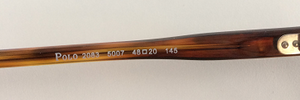
In the photo below, we can see that the width of the lens gauge is 48mm, the width of the nose is 20mm and the length of the temples is 145mm.
Frame sizes
Some frames come in just one size, while others are available in 3 different sizes, so how do you find your way around?
case1: You already wear glasses
If you already wear glasses, you can refer to the size shown on your frame as we saw earlier, and then order the frame size that's closest to the one you currently have.
If you wear glasses but the frame size is not shown on the temple, you can take the frame measurement as explained in the diagrams above, bearing in mind that the most important measurement is the lens width.
2nd case: you're buying glasses for the first time
In this case, you don't have any measurements to quantify the frame size you need.
However, there is a technique you can use to get an idea of the frame size you need.
Take a credit card, its width about the same as a standard-sized lens. Place it so that one side touches the bridge of your nose, and look at yourself in a mirror or on a screen with a webcam. There are then 3 possible scenarios that will help you decide which frame size to use.
- If the other end of the card coincides with the end of your eye on the temporal side, a standard frame size should suit you.
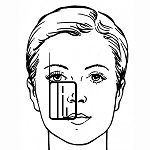
- If the end of the card protrudes beyond your eye, you'll need a small frame.
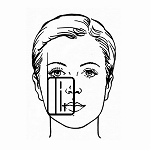
- If the credit card doesn't reach the end of your eye, you'll need a large frame.
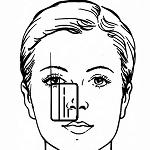
Whether you've worn glasses before or not, you now have everything you need to choose the right frame size for your next order.







 Loading...